
Made for the curious. Free in web beta.
 Your real-time AI tour guide.
Every street has a story.
You walk. GAID researches the places you pass, tells their stories, and answers your questions along the way.
Pronounced “guide”. iOS and Android apps coming soon.
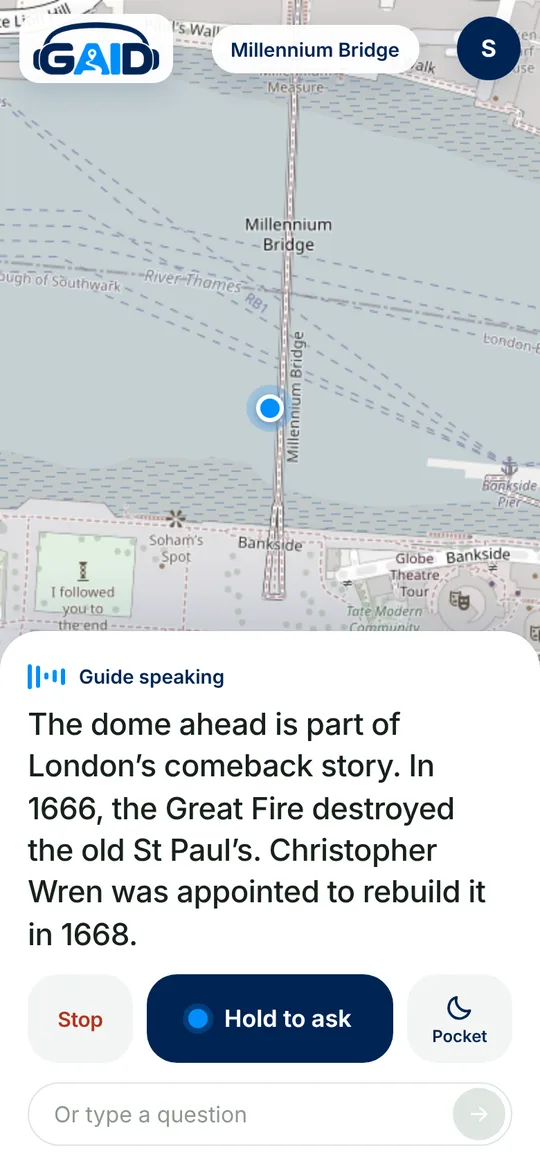
Millennium Bridge, London
01 / The world, a little closer
Walk into
a story.
That doorway. That dome. That street you’ve crossed a hundred times.
GAID is an AI walking tour guide that researches nearby places in real time, turns them into audio stories, and lets you ask what happens next. Look up. There’s more here than you think.


Places shown illustrate the experience. Destination coverage is being tested in the beta.
02 / Walk. Listen. Ask.
An audio tour.
With a conversation inside.
A real place. An example walk.
A glimpse of what curiosity
can do.
St Paul’s Cathedral Sample conversation
A skyline rebuilt
from the ashes.
The dome ahead is part of London’s comeback story. In 1666, the Great Fire destroyed the old St Paul’s. Christopher Wren was appointed to rebuild it in 1668. What you see today began with a city imagining what could come next.
Wren was the architect appointed to rebuild St Paul’s after the Great Fire. His cathedral helped reshape London’s skyline.
One dome.
A clever secret inside.
From the street, St Paul’s looks like one enormous dome. Wren’s design is more ingenious: an inner dome, a supporting brick cone, and an outer dome. The inside and the skyline could each have the shape they needed.
The layers serve different purposes: an interior ceiling, structural support for the lantern above, and the outer profile you recognise from London’s skyline.
A phoenix hiding
in plain sight.
On the south side of St Paul’s, a carved phoenix rises from flames. Beneath it is the Latin word “Resurgam”: “I shall rise again.” A small detail holds the cathedral’s whole story of rebuilding after the fire.
A phoenix rises again from its ashes. Here it represents St Paul’s returning after the destruction of the Great Fire of London.
Illustrative preview. Story source: St Paul’s Cathedral
03 / Less planning. More noticing.
Your next walking tour
starts with a step.
Three simple moments.
A different way to see a place.
-
01
Go where you want.
Open GAID on your phone and share your location. Your surroundings become the starting point.
-
02
Hear what’s around you.
GAID researches nearby places as you move, then turns what it finds into spoken stories.
-
03
Ask the next question.
Architecture? Local history? One fascinating detail? Follow the thread that catches your interest.
04 / Your curiosity, in the conversation
Beyond
“press play”.
A recorded audio tour tells a prepared story. GAID is designed to research what’s around you now, then respond when you want to know more.
AI tour guides, explained| The experience | Recorded tour |

|
|---|---|---|
| Your route | Typically set stops | Around your walk |
| The stories | Prepared in advance | Researched as you go |
| Your questions | A one-way recording | A conversation |
A comparison of formats. GAID is currently in beta.
The web app is open
Your next walk
has a story.
Be one of the first people to walk with GAID. Create a free account and take your first walk today. Your feedback shapes what comes next.
Web app first. iOS and Android apps coming soon.
Start in ten seconds.
- Name, email and a password. No email to confirm.
- Pick what you love hearing about.
- Put your headphones in and walk.
Already have an account? Log in
What is an AI tour guide?
An AI tour guide uses artificial intelligence to explain places and answer questions. GAID takes this into your walk: it researches nearby streets, buildings and landmarks, tells audio stories, and responds to your curiosity in real time.
How does GAID work while I walk?
GAID uses your location to understand the places around you. As you move, it researches your surroundings and tells relevant stories. You can ask follow-up questions about what you hear or the places you notice.
Can I ask questions during the tour?
Yes. Ask who designed a building, what happened in a square, or why a landmark matters. GAID responds so you can explore a story in more depth.
Do I have to follow a fixed walking route?
GAID is designed around your changing surroundings rather than a sequence of recorded tour stops. Walk wherever you like: the guide follows you with GPS and talks about whatever is around you.
Is GAID available on iPhone and Android?
The current beta is a web app that runs in a browser. Native iOS and Android apps for the App Store and Google Play are coming soon. Until then, create a free account and use it in your phone’s browser.
Do I need an internet connection?
Yes. GAID needs an internet connection for live research and answers. For a real walk, location permission is also needed so the guide can understand your surroundings.
How reliable are AI-generated tour stories?
AI can make mistakes, and GAID is in beta. Check important historical details against reliable sources or information at the location. Feedback from beta testers helps us improve the experience.
How do you pronounce GAID?
Like “guide”. The AI in GAID is highlighted because that’s exactly what it is: an AI guide.